
In May 2025 I sat in a working group on integrated workforce planning inside one of the largest government institutions in the country. Around two hundred senior workforce planners were in the room. During the Q&A I asked the director who had convened the session two questions. What was the institution doing to prepare for the impact of artificial intelligence on workforce design. And what was it doing about the shift in the recruiting pool, as middle managers from the commercial sector moved toward government roles they judged to be more AI-resistant.
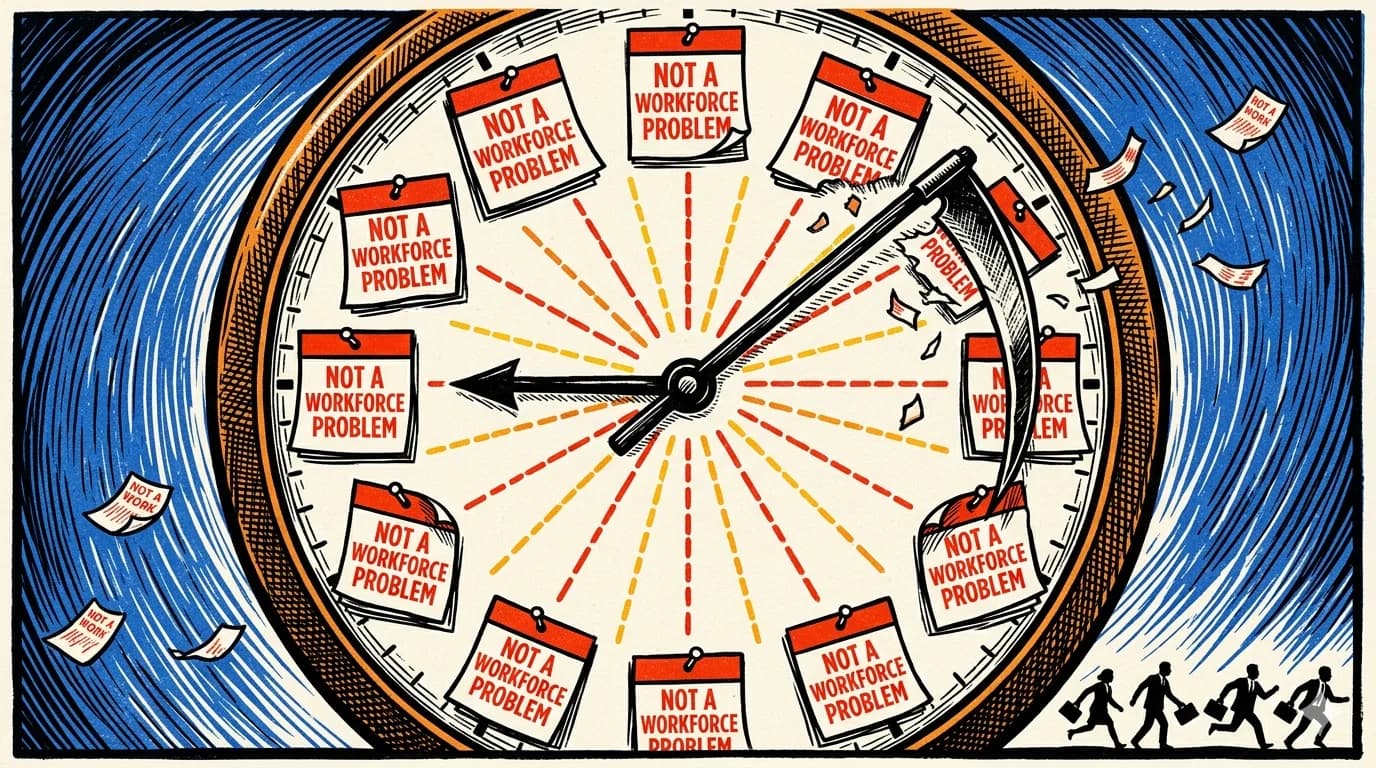
Her answer has stayed with me. She told the room that AI was not a workforce problem. Her team were not looking at it. That was a matter for the data function.
I did not yet have the evidence to push back. The confidence in the answer was total, the problem set was already fully formed in her head, and I watched two hundred of the most senior workforce planners in that institution nod and move on.
Twelve months have now passed. The evidence has arrived, and it has not arrived quietly.
The Snap signal
On 15 April 2026, Snap announced it was cutting 16 percent of its workforce, roughly 1,000 people. CEO Evan Spiegel explicitly cited AI-driven efficiencies. More than 65 percent of new code at Snap is now AI-generated. The stock closed up 7 percent on the day.
That 7 percent is the part that matters. For three years, technology press covered AI layoffs as an HR story: sad, inevitable, some hand-wringing, lots of op-eds. The Snap move turns it into something different. It is the first widely-covered case of public markets explicitly rewarding an AI-driven headcount reduction. Once investors reward one CEO for the move, every other CEO with a board and a quarterly earnings call has a new reference case.
Before 15 April, the argument for using AI to cut workforce was still, in most boardrooms, contested. The counterargument was respectable: reputational risk, brand damage, union trouble, regulatory exposure, the possibility of being wrong about the tech's readiness. That counterargument still exists, but it now has to compete with a fresh market-priced data point showing the reward for making the cut exceeds the reward for not making it.
This is how incentive cascades work. An individual CEO does not need to believe AI is better than people at the task being eliminated. They need to believe the next investor call will go worse if they have not done what Snap did. The fiduciary pull is toward mimicking the rewarded behaviour, not toward optimising the underlying question.
The Q1 2026 numbers suggest this was already happening before the Snap announcement. Roughly 80,000 tech workers cut across the quarter, with 48 percent directly attributed to AI. Oracle dropped an estimated 20,000 to 30,000 staff. Goldman Sachs data puts AI displacement at around 16,000 US jobs per month. What Snap added was not the volume. It was the price signal. The market has now announced its preference.
The 22-to-25 cohort is the first casualty
Stanford's AI Index 2026 reports that employment among software developers aged 22 to 25 has dropped nearly 20 percent since 2024. This is not a coincidence. The work AI replaces first is the work junior professionals used to do: documented, routine, predictable, specified. The entry-level rung of the ladder is the one being sawn off.
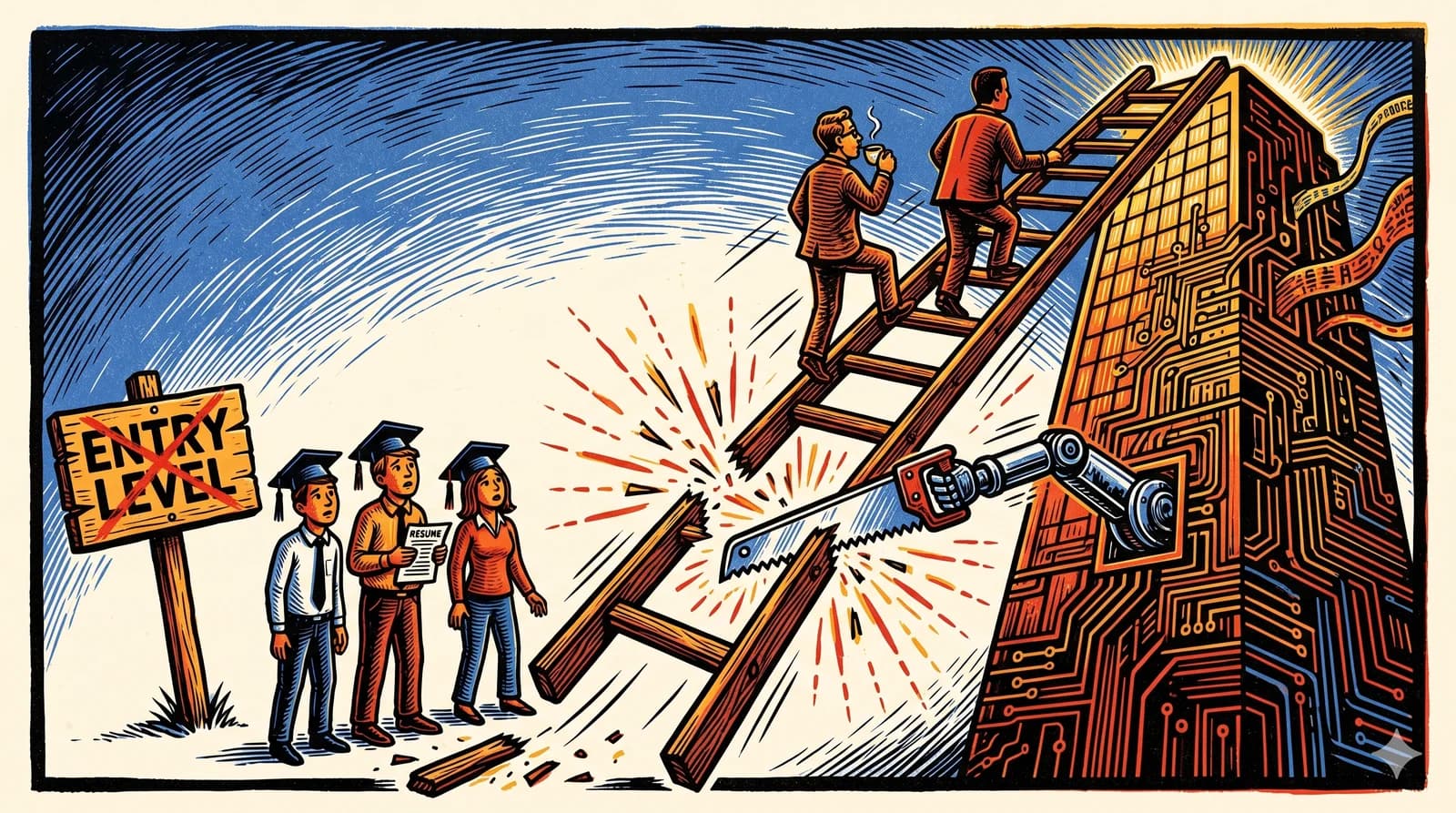
The generational consequence will sit with the public sector and government for a decade. A cohort that cannot find an entry-level role in 2026 is a cohort that is not developing domain expertise in 2030 or leadership capacity in 2035. The institutional talent pipeline is a generation-scale asset. It is being compromised by a quarter-scale incentive structure.
The twelve-month cost
The institution in that May 2025 meeting has spent twelve months on a path that will now have to be undone. That cost is not exotic. It is the ordinary cost of treating the workforce question as someone else's problem. The confidence with which the question was dismissed was, in hindsight, the symptom rather than the argument. It was easier to redirect the question than to own it, because owning it meant being accountable for an answer the institution did not yet know how to produce.
The planning cycles inside most large organisations are structurally incompatible with this news velocity. A five-year strategic workforce plan signed off in 2024 did not model a 20 percent cut in junior developer employment. An 18-month procurement cycle for training providers cannot retrain staff faster than their role is being obsoleted. An annual budget review reacts a year after the wave.
The organisations that adjust fastest share a structural trait. They have one named role that owns "workforce design" as distinct from "technology rollout". When the two are separated, someone is actually accountable for the trade. When they are collapsed, adoption becomes a procurement exercise and the workforce question is treated as someone else's problem. Six months later, the adoption rate sits at 12 percent and the programme is restructured.
What changes this quarter
The practical move for senior HR and government leaders reading this in April 2026 is specific and narrow. Assume that within two earnings cycles or two budget cycles, boards and ministers will be asking a sharper version of the question Snap's board is now asking. Where is the AI-driven efficiency in our workforce, and why is it not larger? The next-best move is to arrive at that conversation with a workforce-design answer ready, rather than a panicked cost-out exercise.
That means naming, this quarter, the individual accountable for workforce design in each business unit or division. It means publishing, this quarter, a one-page model-selection guide so teams stop making bad default choices on tool use. It means identifying, this quarter, the roles where AI augmentation creates capacity versus the roles where AI substitution creates risk. None of these three moves requires a new strategy document. They require assigning accountability before the market or the minister asks for it.
The thing the commentary will miss
The commentary around the Snap announcement will frame this as an ethical question, a technology question, or a labour-market question. It is all three, but primarily it is a governance question. The signal is not that AI can replace people. The signal is that public markets, and soon ministerial expectations, have priced in that assumption, and the leaders who act on it will be rewarded.
That signal will not unspoil. Every executive team and every senior public-service leader who has been debating their AI strategy now has an external pull toward a particular shape of strategy, whether or not that shape is actually the right one for their organisation.
The work for senior leaders who want to stay ahead of the cascade is not to pretend the signal is not real. It is to design a workforce response sharper and more deliberate than the one the market is about to demand. Speed and precision are the scarce commodities. The institutions that produce both will run their AI integration on their own terms. The ones that produce neither will do it on Snap's terms, at a pace set by someone else's earnings calendar. The twelve-month clock is already running for the institution that decided the question was someone else's problem.
If the name is blank, the twelve-month clock is already running.
Sources
- Snap's stock jumps on plans to axe 16% of its workforce, CNBC
- Tech industry lays off nearly 80,000 in Q1 2026, Tom's Hardware
- AI is cutting 16,000 US jobs a month, Fortune
- Snap cuts 1,000 jobs citing AI, TechRepublic
- Inside the AI Index: 12 Takeaways from the 2026 Report, Stanford HAI
- Young workers' employment drops in occupations with high AI exposure, Federal Reserve Bank of Dallas