
On 21 March 2026, inside a decommissioned power plant in Austin, Texas, Elon Musk announced a chip factory targeting 50 times the current annual output of every semiconductor facility on Earth.
Combined.
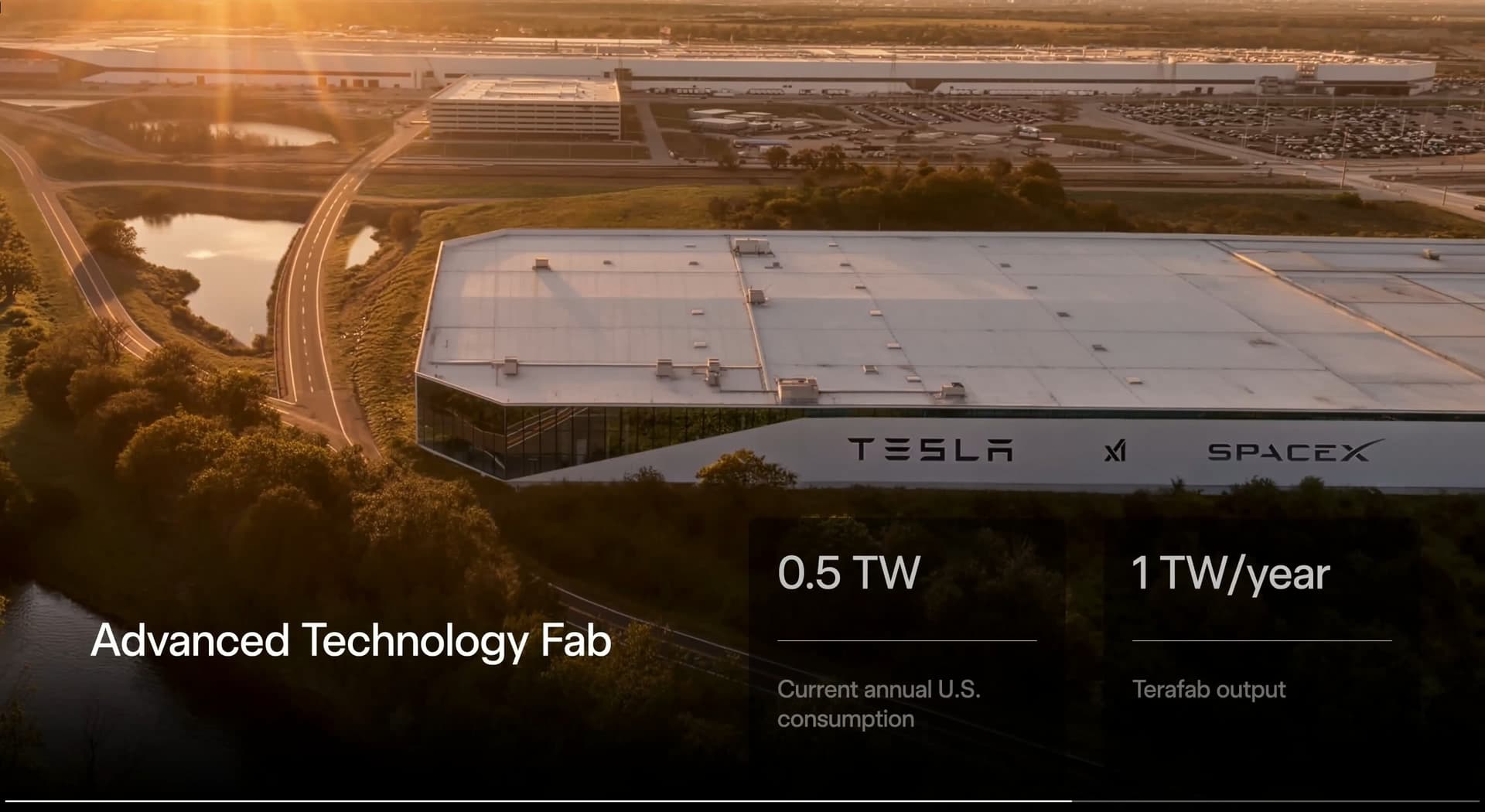
One terawatt. That is the target. Current annual US electricity consumption: 0.5 terawatts. One facility, producing twice the compute capacity of the entire American power grid. Most of the internet treated this as another Musk press conference. It was not. It was the reveal of a vertically integrated compute supply chain stretching from raw silicon to low Earth orbit, designed to feed four concurrent projects that would each, individually, be the most ambitious thing any other company has ever attempted.
He announced a shed. The shed is a country. Literally. One hundred million square feet. Nearly four times Vatican City and Monaco combined. A chip factory with a larger footprint than two sovereign nations, with room to spare.
Footprint comparison (million sq ft)
Terafab: 100M sq ft confirmed by Musk on X, 22 March 2026. Country areas from CIA World Factbook.
The vertical stack
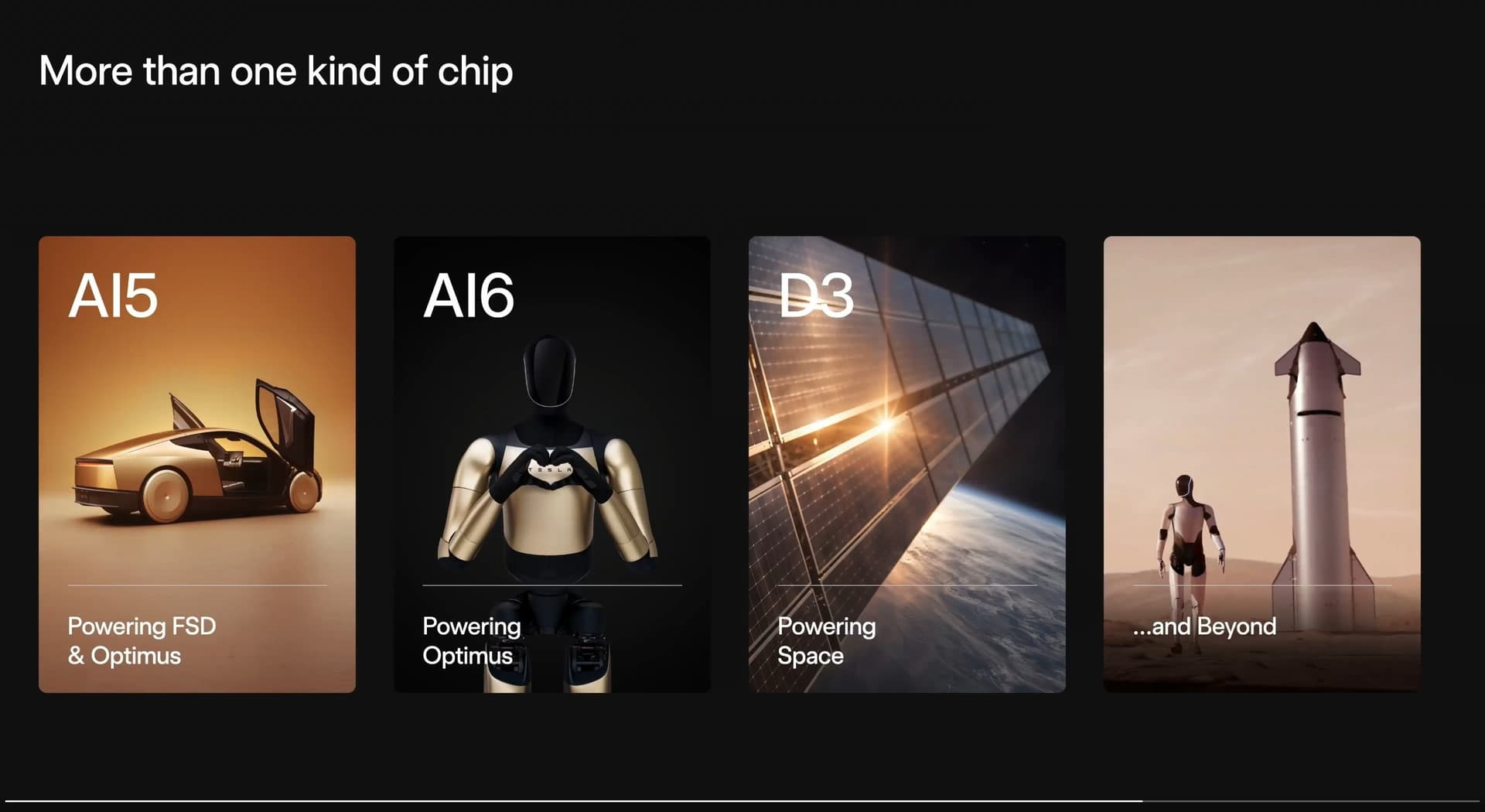
Terafab is a joint venture between Tesla, SpaceX, and xAI. Three chip families, not two. The AI5: fifth-generation edge inference silicon powering Full Self-Driving and Optimus. The AI6: next-generation silicon dedicated to Optimus robots, revealed on a single presentation slide and barely mentioned. The D3: radiation-hardened processors built for orbital deployment. And a fourth column on that slide simply read "...and Beyond." Everything under one roof: design, lithography, fabrication, memory, advanced packaging, testing. USD 20 to 25 billion. Not yet in Tesla's 2026 budget, which already exceeds USD 20 billion.
A project costing more than the GDP of 80 countries, announced without a budget line. Remember that number. It comes back.
But the cost is not the story. The vertical integration is the story. Musk is not building a chip factory. He is building the substrate for a flywheel that most people have not yet recognised as a flywheel.
The flywheel
Each of Musk's four projects feeds the others. Terafab is the piece that locks the loop closed.
Tesla autonomy needs custom inference chips to run Full Self-Driving without cloud dependency. Millions of vehicles, each requiring silicon that does not exist in sufficient quantity. Terafab produces the AI5. More chips mean more autonomous vehicles. More autonomous vehicles generate more real-world driving data. More data means better FSD models. Better models accelerate the robotaxi fleet. The robotaxi fleet generates revenue. Revenue funds more chips.
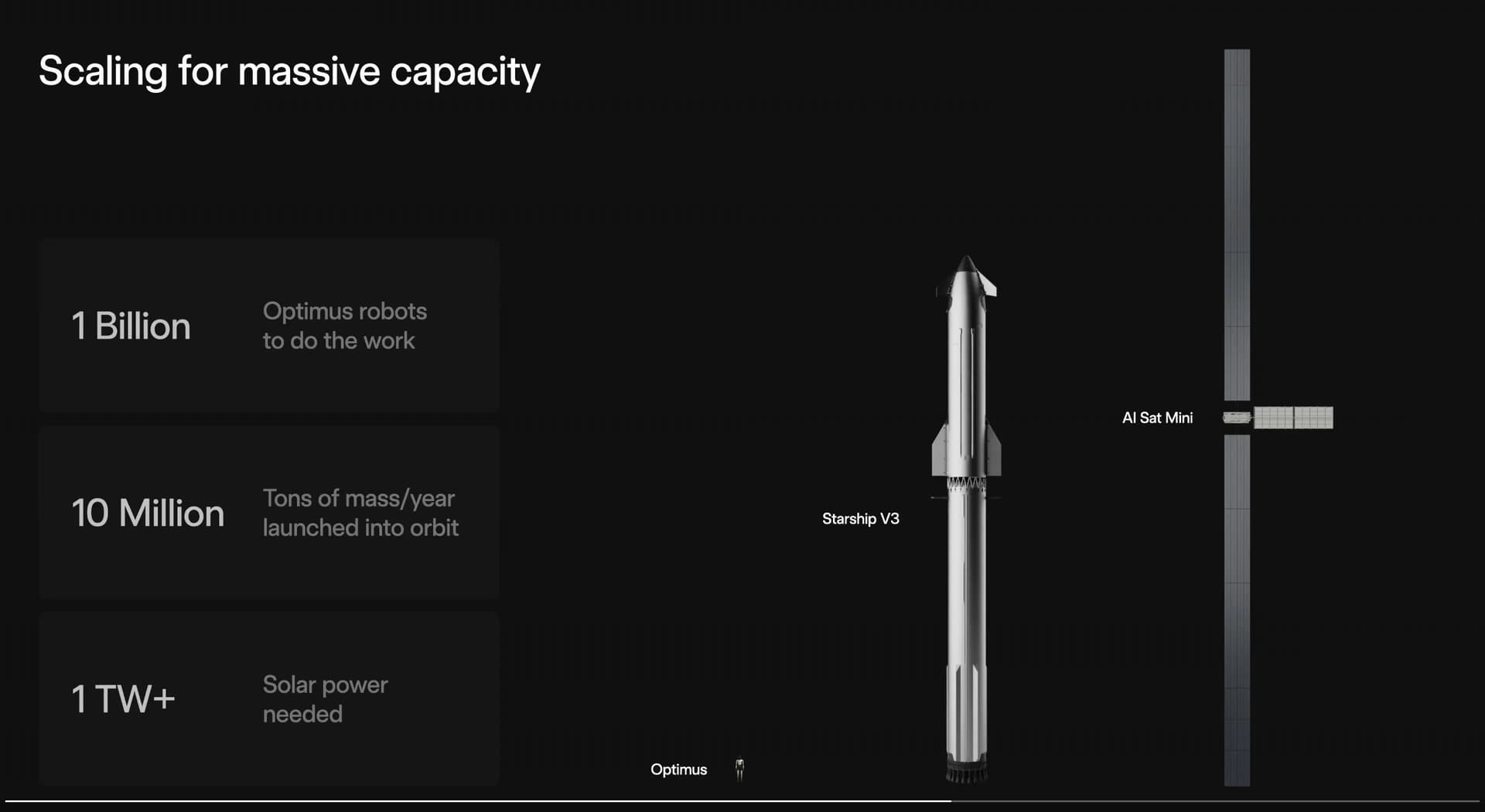
Optimus starts on AI5 and graduates to dedicated AI6 silicon. The target: one billion robots. Not millions. Billion. The humanoid robot programme has always had a dependency problem: you cannot scale to a billion units if your chip supply is rationed by TSMC's allocation schedule. Terafab removes the bottleneck. More robots in factories means faster manufacturing. Faster manufacturing means cheaper robots. Cheaper robots means faster deployment. Each unit generates economic output that funds the next generation. A billion robots, each producing economic value, each running on silicon from one facility.
The orbital constellation absorbs 80 per cent of Terafab's output. One million data centre satellites, filed with the FCC on 30 January 2026, operating at 500 to 2,000 kilometres altitude. Each satellite: roughly 100 kilowatts of compute, dominated by solar arrays and a 100-square-metre radiator. A million of them: 100 gigawatts of orbital processing. That is approximately five times the total compute currently deployed in every terrestrial data centre on Earth. Getting them there requires 10 million tons of mass launched per year. SpaceX already launches more mass to orbit than every other entity on Earth combined. Starship will increase that capacity by an order of magnitude. Cheaper launches mean more satellites. More satellites mean more orbital compute. More compute means more revenue. More revenue means more launches.
xAI needs training compute for Grok and whatever comes after Grok. The Colossus cluster in Memphis was built in 122 days. Terafab is the permanent supply line. More compute means better models. Better models mean more users. More users mean more revenue. The loop continues.
Four projects, one chip supply, zero external dependencies. That is not a factory. That is a closed-loop industrial economy.
Each loop reinforces the others. Tesla data improves the models that run on xAI infrastructure. xAI models improve the autonomy stack that runs on Tesla silicon. SpaceX launches the satellites that run the compute that trains the models that drive the cars that fund the rockets. Every dollar Musk spends on Terafab feeds every company he owns simultaneously.
The word for this is not "chip factory." The word is "moat."
The Terafab flywheel
Every dollar spent on Terafab feeds every company Musk owns simultaneously.
The space bet
Eighty per cent of output going to orbit sounds like science fiction. It is not. It is physics and economics.
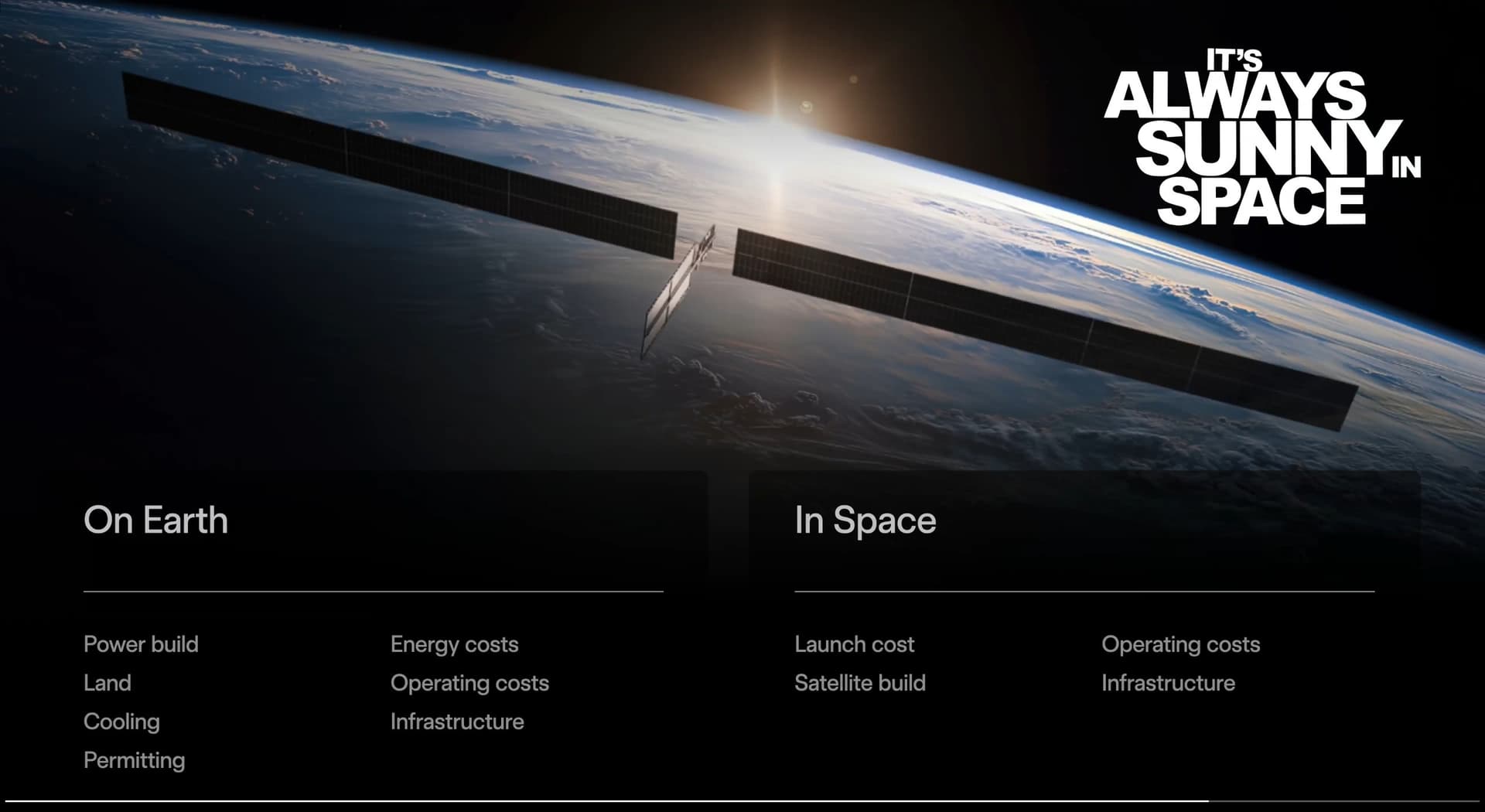
Solar irradiance in orbit: roughly five times Earth's surface. No land acquisition. No grid connection. No cooling infrastructure, because vacuum handles heat rejection for free. Musk claims orbital AI will be cheaper per watt than terrestrial data centres within two to three years.
SpaceX framed this as "a first step towards becoming a Kardashev Type II civilisation." We are currently a Kardashev 0.73. We cannot keep the lights on in Texas during summer.
But strip away the civilisational grandeur and the economics are straightforward. If you can manufacture your own chips, launch your own rockets at 10 million tons per year, and power your own satellites with free solar energy, the marginal cost of orbital compute drops toward zero over time. One presentation slide, titled "It's Always Sunny in Space," laid it out starkly: on Earth, you pay for power infrastructure, land, cooling, permitting, energy costs, and operating costs. In space, you pay for launch and satellite build. The sun does the rest.
You do not need to believe in Kardashev scales to recognise that as a competitive advantage that no terrestrial data centre operator can match.
The FCC accepted SpaceX's million-satellite filing on 4 February. Comments closed 6 March. SpaceX requested a waiver on standard deployment milestones. If approved, the D3 radiation-hardened chip has a buyer. If denied, 80 per cent of Terafab's projected output has no destination.
The scale
One hundred million square feet. Musk confirmed the figure on X the day after the event: "the right order of magnitude." Twelve times Samsung's plant in Taylor. Fifteen Pentagons. Three Central Parks. Nearly four times the combined area of Vatican City and Monaco.
Terafab needs over 10 gigawatts of power. South Australia generates about 4 gigawatts. Two and a half South Australias, before anyone turns on the air conditioning.
At full capacity: one million wafer starts per month. TSMC runs approximately 1.4 million across every facility it operates globally. One site. Seventy per cent of TSMC's planetary output.
No construction timeline was given. A single 2nm fab costs around USD 28 billion and takes 38 months to build. Morgan Stanley estimates the true Terafab cost at USD 35 to 45 billion. The entire Apollo programme cost USD 25.8 billion in 1973 dollars, about USD 200 billion today. Terafab is cheaper than going to the Moon. Not by as much as you would think.
Tesla is targeting 2nm. Tesla has been fabricating chips for zero months.
The "50x" claim rests on Musk's assertion that current global production equals roughly 20 gigawatts of compute. The semiconductor industry measures output in wafer starts, not watts. The conversion is non-standard. Treat with appropriate scepticism.
The sceptic's case
Battery Day 2020. Ten gigawatt-hours of 4680 production within a year. Three terawatt-hours by 2030. Fifty-six per cent cost reduction.
Five and a half years later, the cells exist. Production is ramping. On a timeline that would have deeply disappointed anyone who bought the stock on the original promises. The dry electrode process required six or seven complete revisions. The USD 25,000 vehicle those savings were supposed to fund does not exist.
Analysts have a name for Terafab: "Battery Day on steroids."
Tesla has zero semiconductor fabrication experience. TSMC spent five decades and hundreds of billions to build its capability. Intel, with thousands of experienced engineers and over USD 100 billion invested, has struggled for years to regain its edge. Samsung, despite massive capital, still trails TSMC on yield rates. Three companies on Earth can fabricate at 2nm. Musk wants to be the fourth. He is starting from a position roughly three decades and a hundred billion dollars behind the leaders.
Then there is the vibration problem. Fabrication at 2nm requires the complete absence of vibration at the nanometre scale. The proposed initial site sits adjacent to Giga Texas, where stamping machines shake the ground continuously. A facility requiring molecular stillness, next to a building that punches metal all day.
The demand signal
Here is where the sceptic's case runs into its own contradiction.
Musk projects that miss by 90 per cent still reshape industries. Battery Day fell dramatically short. The 4680 cell exists. It forced every competitor to accelerate. SpaceX was impossible until it was not. The Falcon 9 now launches more often than most people update their phones.
Ten per cent of the Terafab target is 100 gigawatts. Five times the current output of all advanced-node fabs worldwide. A "failed" Terafab would be the largest semiconductor facility ever built.
But the bigger point is not whether Musk delivers. It is what the demand signal tells you.
He is publicly declaring that his companies need 50 times current global chip output. Discount it by 90 per cent. The remainder is still larger than any single entity has ever required. That number is not aspirational branding. It is a calculation derived from specific, identifiable demand: millions of autonomous vehicles, one billion humanoid robots, a million orbital satellites requiring 10 million tons of annual launch mass, and an AI training operation that already built the world's largest cluster in four months.
Remember the GDP figure from earlier. Eighty countries worth of spending, no budget line, and the analysts think it is too low. That tells you something about the scale of what is coming, regardless of who builds it.
The compute requirement is real even if the facility is not. Someone will build it. The question is who, and whether the rest of the world recognises what it means before it is operational.
The question is not whether the world needs this much compute. It is whether the world is ready for what happens when one company controls the supply.
The Australian angle
The pattern is familiar. Australia mines the raw materials that become semiconductors. Lithium, rare earths, silicon. Five per cent of the value chain. The other 95 per cent happens in Taiwan, South Korea, the United States, and the Netherlands.
Terafab further concentrates advanced production in America. Australia has no sovereign fabrication capability. No credible plan for one. Our contribution to the compute era: digging things out of the ground and shipping them to countries where they become the most valuable products in human history.
ASML holds a monopoly on EUV lithography. Whoever controls the fab controls the future. Three companies manufacture at the nodes Terafab is targeting. Musk wants to be the fourth. Australia is not in the conversation. We are not even in the building.
What to watch
Three signals will tell you whether this is an inflection point or an elaborate fundraising narrative.
The ASML relationship. No EUV machines, no 2nm fab. ASML has a multi-year backlog. Secured commitments mean this is real. No commitments mean years of delay.
The talent pipeline. Semiconductor fabrication expertise is among the scarcest human capital on Earth. TSMC has struggled to staff its Arizona fabs. Tesla faces the same constraint, amplified by starting from zero.
The FCC ruling. Approval means the D3 has a buyer and the orbital flywheel spins up. Denial means 80 per cent of projected output has nowhere to go. Watch the ruling. Everything else is commentary.
Sources
- Terafab - Wikipedia
- TERAFAB Launched: Here Is What Elon Musk Actually Built - FinTech Weekly
- Tesla and SpaceX announce $25B Terafab chip factory - Electrek
- Elon Musk announces TeraFab - Data Center Dynamics
- Elon Musk formally launches $20 billion TeraFab - Tom's Hardware
- SpaceX files plans for million-satellite orbital data center - SpaceNews
- SpaceX offers details on orbital data center satellites - SpaceNews
- FCC DA-26-113: Space Bureau accepts SpaceX filing
- Everything Announced at Tesla's Terafab Event - NotATeslaApp
- Giga Texas transformed the Austin landscape - Sherwood News
- Musk's Terafab Fever Dream - Bloomberg
- Tesla's Strategic Crossroads - Primary Ignition
- Global Semiconductor Fab Capacity - SEMI
- SpaceX Terafab livestream - X