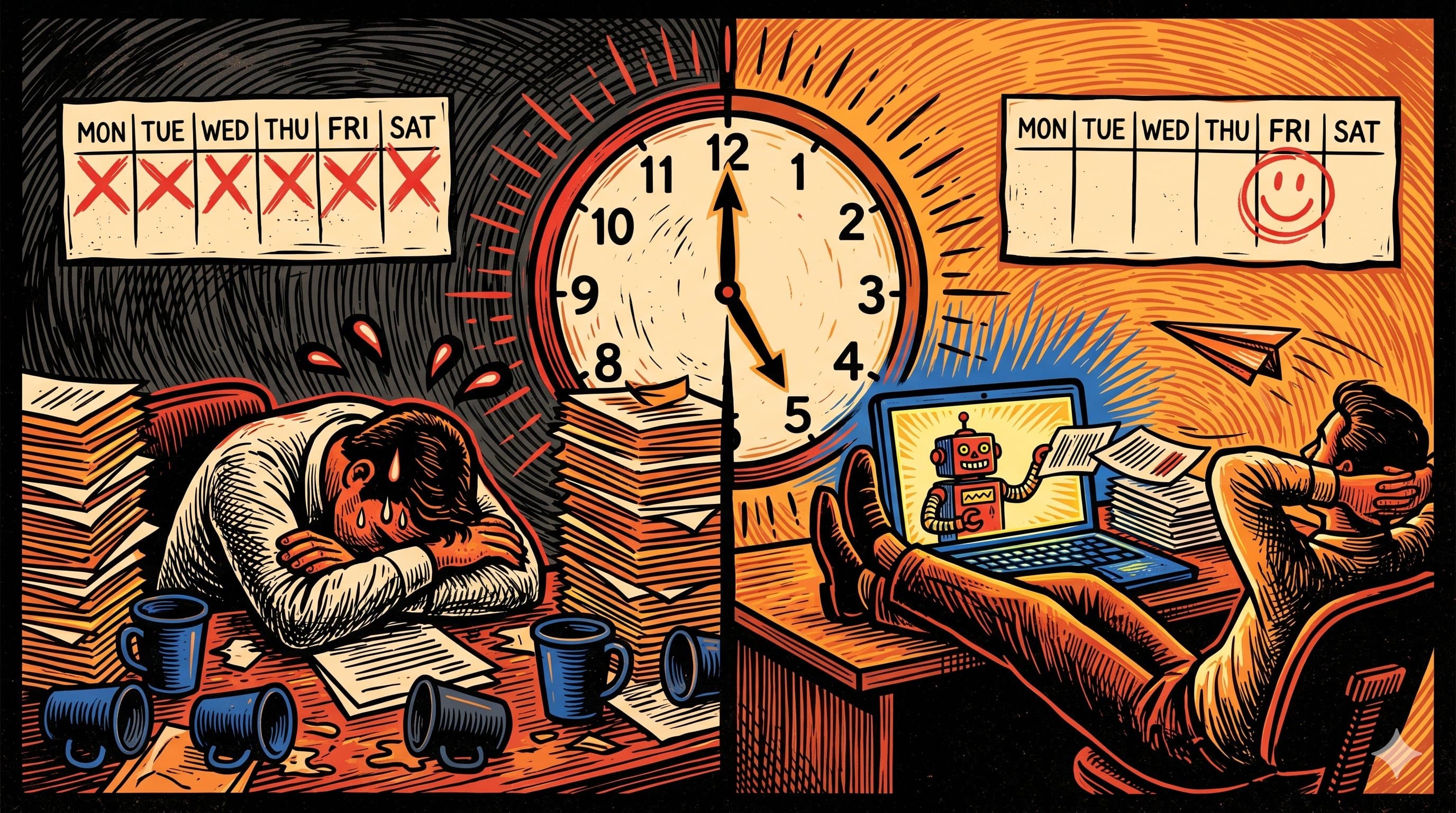

The research on AI productivity keeps landing on the same uncomfortable number. Workers who actively use AI save an average of 7.5 hours per week, according to a joint study by the LSE's Inclusion Initiative and consulting firm Protiviti, which surveyed nearly 3,000 workers and 240 executives globally. At a standard five-day, seven-and-a-half hour working day, that is the equivalent of an additional working day.
If you are not among those workers, you are not in a neutral position. You are doing the equivalent of unpaid overtime relative to your AI-using peers, and you have been doing it since roughly 2023.
Your colleagues are not superhuman. They have adopted a set of tools that compresses the time cost of certain categories of work. The gap between them and you is not talent. It is fluency.
HR leaders already know what is coming
In November 2025, CNBC's Workforce Executive Council surveyed senior HR leaders across industries. Eighty-nine percent expect AI to have a meaningful impact on their workforce in 2026. Forty-five percent believe it will affect more than half of all roles in their organisation. Eleven percent believe there will be no impact, which is the kind of confident forecasting that makes for interesting reading in retrospect.
What is notable about this data is not the 89%. It is what the 89% are being asked to manage. Workers using AI outperform peers on most measurable productivity dimensions. AI tools continue to improve. The cost of not having AI fluency in your workforce is measurable and growing each quarter.
The organisations that build AI fluency across their teams early will extract compounding returns. The ones that treat this as an IT procurement question rather than a workforce development question will spend the next few years explaining why their productivity numbers look flat against industry benchmarks.
What the job market is already signalling
Researchers at Harvard Business School published analysis in HBR in March 2026 tracking job postings across the US economy from 2019 through early 2025. Their findings were direct: postings for roles most exposed to AI automation fell 13% after ChatGPT's public launch. Postings for analytical, technical, and creative roles, which tend to involve AI as an amplifier rather than a replacement, grew 20%.
The market has not waited for a policy announcement. It is already redirecting demand toward workers who can operate alongside AI effectively, and away from roles where AI can substitute for the function entirely.
The market has not waited for a policy announcement. It is already redirecting demand toward the workers who can operate alongside AI.
The same research found that 94% of workers surveyed prefer AI to be used as a collaborative tool rather than a replacement. This is not a fringe view. It is nearly unanimous. People are not resistant to AI fluency because they fear the technology. Most of them want to develop it.
The barrier is almost never attitude. It is access, training, and permission.
The training gap that explains most of what follows
Here is the part that should concern anyone responsible for a team: 68% of workers have received no AI training in the past 12 months. This is from the same LSE/Protiviti study that documented the 7.5-hour productivity gain.
The same study also found that trained users saved 11 hours per week. Untrained users saved 5 hours. The gap between trained and untrained is not a feature of the technology. It is the difference between someone who understands how to delegate effectively and someone who is typing the same prompts they found on LinkedIn.
The LSE/Protiviti research valued the 7.5-hour weekly saving at approximately $18,000 per employee per year in productivity gains. Across a team of 10 untrained workers each capturing 5 hours instead of 11, the gap represents roughly $720,000 in unrealised annual productivity per team. That is a workforce development budget justification that writes itself.
Organisations are, in many cases, deploying AI tools to workers they have not trained to use them effectively, capturing a fraction of the available productivity gain, and then attributing the gap to the technology rather than the implementation.
The upskilling timeline that is already running
Gartner published research in October 2024 finding that generative AI will require 80% of the engineering workforce to upskill through 2027. This is not a prediction about a future disruption. It is a description of a process already underway, visible in hiring patterns, job description requirements, and the daily experience of any developer who has watched a junior colleague hand a routine task to a coding agent in the time it used to take to set up the file structure.
The 2027 deadline is not generous. For organisations that have not yet begun structured AI upskilling programs, the runway is short.
Gartner's HR survey, published in December 2025, found that 65% of employees are already excited to use AI at work. The adoption readiness is there. What is missing in most organisations is the structured pathway to build the skills.
The practical question
The LSE/Protiviti finding about trained versus untrained workers matters because it reveals where the leverage actually is. If you are currently saving 5 hours per week through AI tools, moving toward 11 is a workflow and knowledge problem, not a subscription or hardware problem.
The gap between 5 and 11 hours is not a better AI model. It is a clearer mental model of how to use the ones you already have access to. It is knowing which tasks to delegate to an AI agent, which outputs require verification, and how to structure your work so that AI handles the mechanical and preparatory phases while your judgment is applied where it actually matters.
Workers who have developed this fluency are not doing more work. They are doing the same amount of work in four days and using the fifth day to do things that only humans can do well: relationships, judgement calls, creative synthesis, strategic direction.
Whether you are managing a team or managing your own career, the question is the same: are you in the group capturing 11 hours per week, or are you in the group that has not yet been trained?
The time saved does not redistribute itself. It accrues to whoever claims