
Australia released its National AI Plan on 2 December 2025. By the standards of government, that is recent. By the standards of a technology that doubles in capability every sub-90 days, the plan was outdated before the ink dried.
The lag between policy and capability is not new. What makes it dangerous now is the gap between what Australia is doing and what our regional competitors have already done. Singapore has built AI adoption into the bones of its economy. We are still debating whether we should have a governance framework.
The numbers that define the gap
The adoption figures tell a story that Australian leadership is only beginning to acknowledge.
Singapore's AI adoption rate sits at 60.9%. The UK is at 36.4%. Australia's small and medium enterprises are somewhere between 29% and 37%, depending on who is measuring and what they count as adoption.
When you ask Australian leaders whether the country has the capability to meet future AI requirements, only 7% say we do so to a great extent. Forty-five per cent of CEOs cite internal skills as the single largest barrier to faster adoption. That is not a minor constraint. That is the majority of the executive leadership cadre saying the problem is them, not the market.
Geography compounds the adoption gap. Metro areas achieve adoption rates around 40%. Regional Australia sits at 29%. The coastal concentration of AI infrastructure and talent mirrors the concentration of capital, and Australia's policymakers have not yet reached consensus on whether this is acceptable or whether redressing it is urgent.
The skills crisis nobody is solving fast enough
The adoption gap connects directly to a skills crisis that the current policy response is not moving at pace to address.
Only 41% of Australian workers feel their workplace is prepared for AI. Over 160,000 AI specialists are projected to be in shortage by 2030.
The government's response includes AUD$29.9 million for an AI Safety Institute. Microsoft and FSO launched a Skills Accelerator. These are correct moves. They are also moving on institutional timescales against a problem that compounds on sub-quarterly cycles. By the time a new cohort of AI specialists graduates from a skills programme, the capability floor has risen. Training programmes designed to teach the state of the art in 2025 are teaching the obsolete norm by 2026.
Sixty-eight per cent of workers globally have received no AI training in the past 12 months. Australia is not an outlier. We are exactly where the global average is, which is not a reassuring place to be when the best-in-class is moving three times as fast.
Adoption without transformation
Here is what is happening in Australian enterprises: 61% report improved efficiency from AI. Only 20% see revenue growth.
Sixty-one per cent gain efficiency. Twenty per cent see revenue. That is the signature of tinkering, not transformation.
The gap between efficiency gains and revenue growth is diagnostic. It means organisations are using AI to do the same things slightly faster. They are not using it to do new things, reach new customers, or create new business models. Incremental improvement is what you get when you are not confident in what you are doing, so you optimize around the margins instead of rethinking the core.
Deloitte's 2026 State of AI in Enterprise found that only 28% of Australian respondents have moved 40% of AI pilots into production. Over half expect to reach that milestone within six months. This optimism has been a recurring feature of enterprise AI surveys since 2023. The pattern is consistent: organisations are confident about next quarter. When next quarter arrives, they are confident about the quarter after that.
Pilot-heavy, production-light deployment is a symptom of organisations that do not fully trust their own capability or the stability of the technology. Both are rational concerns. Neither accelerates competitive advantage.
Defence is moving, but slowly
The Australian Defence Force and Defence policy apparatus have not been passive. In January 2026, AUD$40 million was invested in emerging technology including AI for defence. In March 2026, the Department of Defence released Policy Settings for Responsible Use of AI in Defence. The Ghost Bat and Loyal Wingman acquisition programmes are on track for 2026-2040. AUKUS Pillar II identifies AI and autonomy as an immediate priority.
The ADF's approach is measured and responsible. This reflects genuine constraints: defence must think about worst-case scenarios, adversarial use, and consequences measured in sovereignty rather than quarterly earnings. Caution is appropriate.
Adversaries, however, are not waiting for policy frameworks to mature. The speed of advancement in AI-enabled warfare is not constrained by the speed of allied governance. This asymmetry is not new to military affairs, but the pace of change in AI makes it acute.
What the Senate inquiry found
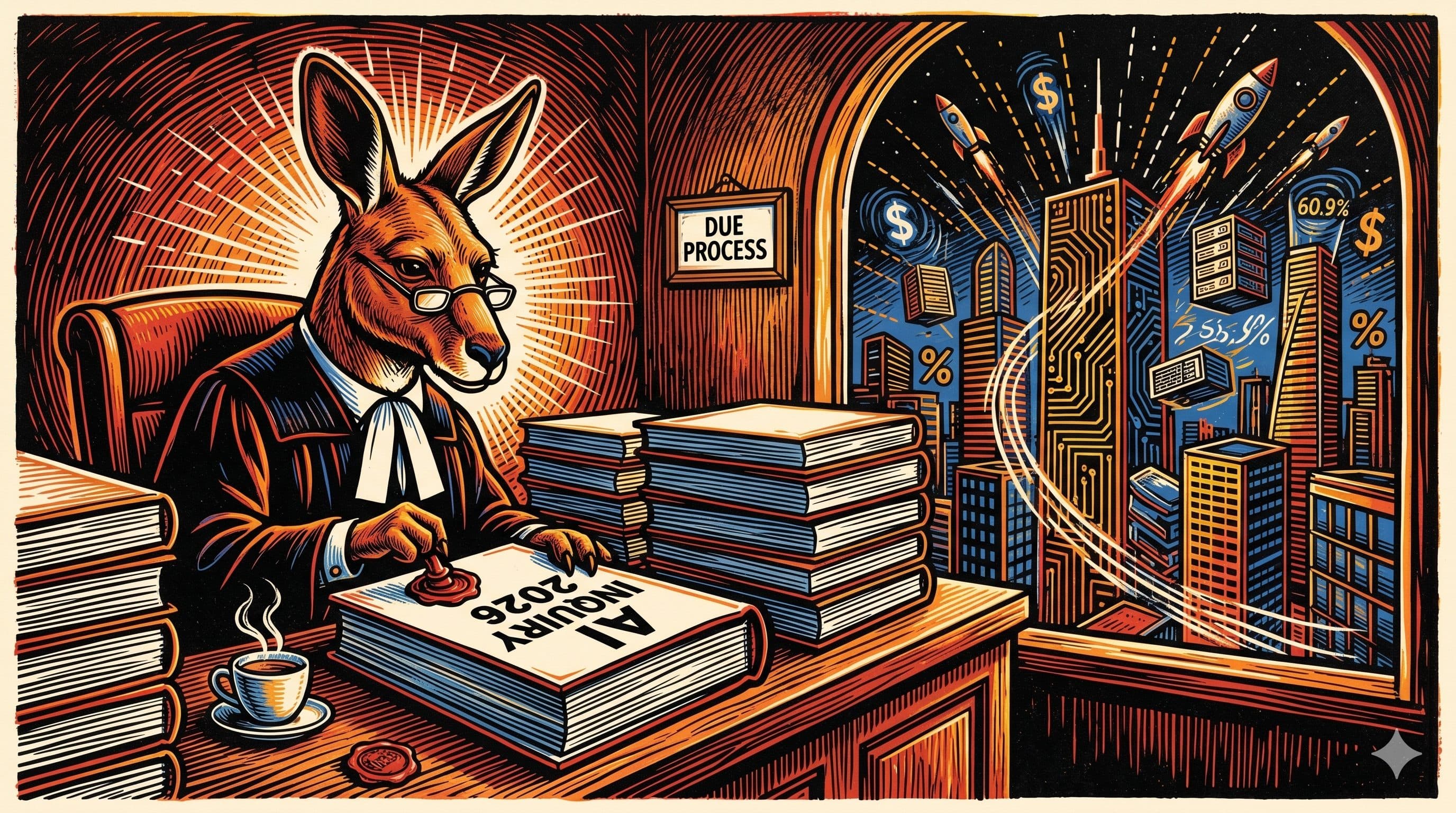
The Senate Select Committee on Adopting AI held six public hearings between its establishment in March 2024 and its final tabling in April 2026. The government released its formal response on 1 April 2026.
The inquiry raised serious concerns about threats to Australian democracy from uncontrolled AI adoption. It called for mandatory guardrails on high-risk AI applications, investment in Australian AI research, and accelerated skills development. These are sound recommendations built on evidence.
The fact that Australia is still at the "inquiry and recommendation" stage in April 2026 is itself the diagnosis. Two years from committee establishment to government response, on a technology that advanced from large language models to multimodal reasoning systems to agentic AI in the same window. The Senate's work was rigorous and necessary. It is also 24 months late by the standard of competitive capability development.
The structural problem
Australia's economic vulnerability to this gap is not incidental. It is structural.
The Parliamentary Budget Office projects that personal income tax will account for 40.4% of federal revenue by 2034-35. AI-driven workforce disruption does not simply affect employment. It directly threatens the tax base that funds defence, health, education, and social security.
The National AI Plan commits AUD$460 million. Consider the scale: Amazon is investing AUD$20 billion in data centres alone. Nvidia's annual revenue exceeds Australia's entire national spending on AI. The funds committed are not small. They are simply incommensurable with the size of the challenge.
The plan has the right pillars. Infrastructure, adoption, governance, skills, research. The architecture is sound. What the plan lacks is urgency proportionate to the speed of change. A three-to-five-year implementation timeline is appropriate for most government initiatives. For a technology on a sub-90-day doubling cycle, it is a recipe for permanent competitive disadvantage.
The closing question
Australia has good people. The scientists, engineers, and strategists working on AI are world-class. We have sound institutions. CSIRO, the ADF, universities, and the private sector are all moving in coherent directions. We have a habit of getting to the right answer eventually.
The question is whether "eventually" arrives before the capability gap becomes permanent. Once a 37% adoption rate falls further behind a 60% adoption rate, the gap compounds. The organisations that move earlier get access to better data, stronger teams, and first-mover learning curves that are hard to catch up to. A regional competitor that is genuinely ahead by two years in AI integration is ahead by a decade in competitive maturity.
The sub-90-day doubling time does not care about Senate inquiries or multi-year implementation plans. It does not wait for the next budget cycle or the completion of the next skills programme. It just keeps doubling.
Australia is not ready. The diagnosis is clear. The clock on response time is already running.