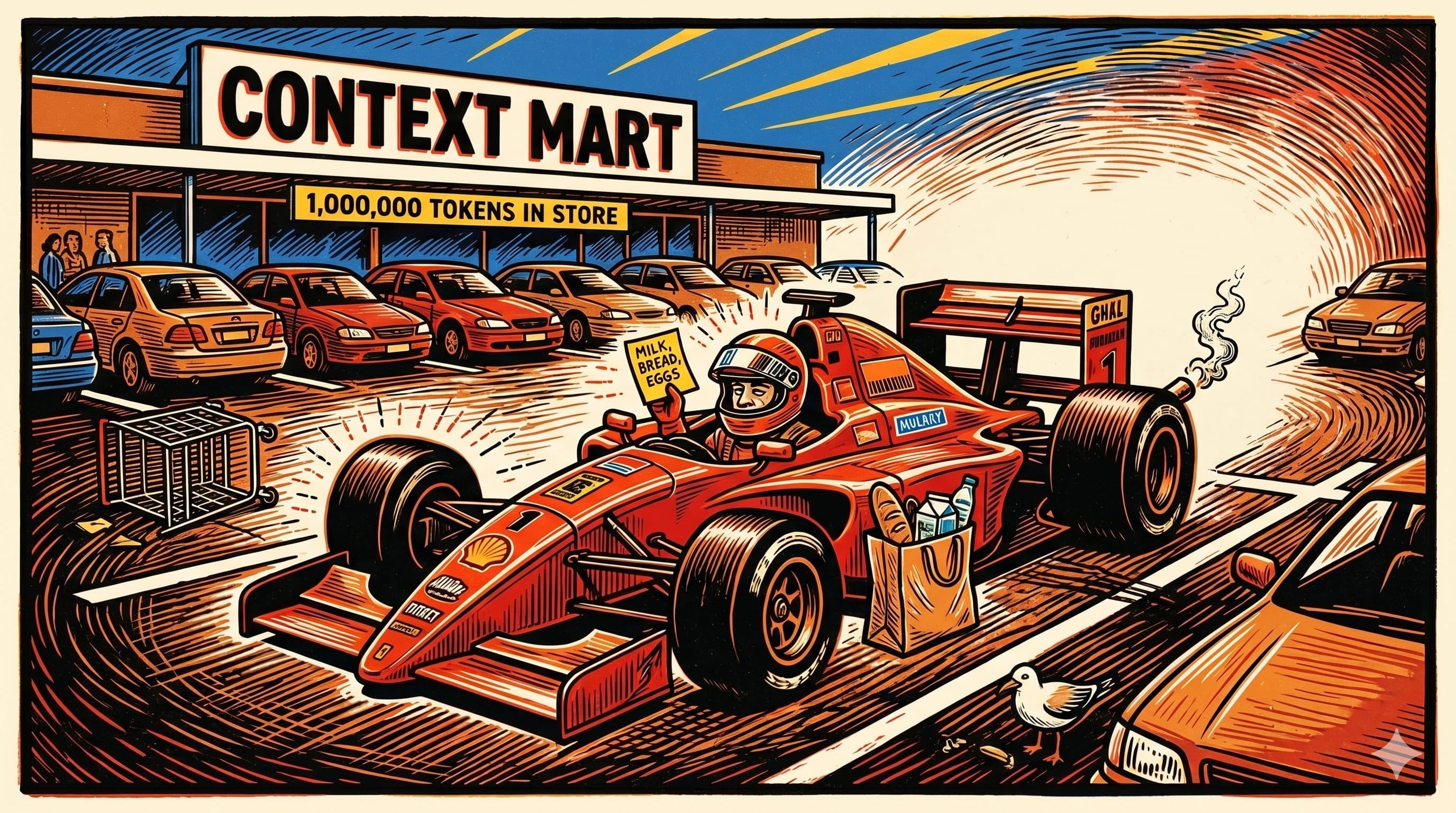

Most people paste a paragraph into ChatGPT and call it AI. They ask a question, get an answer, and move on. The practitioners who are rewriting the rules are doing something fundamentally different. They are feeding entire codebases into a single conversation. They load full research libraries without compression. They dump five years of project history and ask the AI to spot patterns nobody else has seen. The difference between these two approaches is not prompt engineering. It is not model choice. It is the context window, and it has grown so large so fast that most people have not updated their mental models to match what is now possible.
What actually changed
In early 2023, GPT-4 offered 8,000 tokens, roughly equivalent to 6,000 words. By April 2026, Claude Opus 4.6 handles 1 million tokens. That is approximately 750,000 words in a single conversation. In three years, the context window has grown 125 times larger.
Gemini 3.1 Pro sits at the same scale. Meta's Llama 4 Scout pushes further: 10 million tokens. This is not incremental progress. This is a category shift. When a tool multiplies its capacity by 125, the way you use it has to change.
But here is what almost nobody talks about: advertised context size is marketing copy. Real performance is messier.
The gap between theory and practice
A model advertising 200,000 tokens becomes unreliable well before you reach the limit. Research from Chroma shows what they call "lost in the middle" dynamics: information placed at the start of your context retrieves at 85 to 95 per cent accuracy, but information buried in the middle drops to 76 to 82 per cent. Put your most important context in the first 10 per cent of your prompt, and it performs almost perfectly. Put it in the middle 50 per cent, and you are gambling.
Claude Opus 4.6 achieved 78.3 per cent retrieval accuracy at 1 million tokens on MRCR version 2, the highest among frontier models at that scale. That matters. A model that degrades gracefully as you fill the context window is not the same as one that hits a cliff at the 80 per cent mark.
The competitive advantage is not owning a large context window. It is knowing how to use it properly. Most people do not.
What becomes possible at scale
Load an entire codebase for architecture review. Twenty-five thousand lines of code, all visible in one conversation. Ask about patterns the developers missed. Ask what happens if you refactor section seven. Ask whether the dependency graph has hidden fragilities. The AI has everything in view.
Feed five full research papers into a single prompt for comparative analysis. No summaries, no lossy compression, just the raw text. Ask the AI to identify where they agree, where they conflict, what the papers are missing, what the right synthesis looks like. A human researcher would need three hours. The AI does this in seconds, with perfect recall of every source.
Process 200 to 500 page contract sets in one go. Front-load your instruction set: key risks you care about, standard terms you accept, red lines you will not cross. Feed the contracts. Ask for a risk map. Ask which clauses interact with others in unexpected ways. Ask what every signatory would negotiate if they knew what you know.
Run a 50-step agent workflow where decisions made at step three inform decisions at step 47. The AI never forgets what it decided earlier. The conversation becomes a working memory that does not degrade.
The question is not whether these tasks are possible. The question is whether you are actually doing them.
Why most people waste their context
Most practitioners still think in terms of search queries. They paste a few hundred words and ask a question, the way you would ask a search engine. They are using a Formula 1 car to drive to the shops. The mental model is wrong.
AI conversations are not search queries. They are working environments. The more relevant context you load, the richer the output becomes. A model with full visibility into your project history will make different recommendations than one that saw a summary. A model that can read your entire methodology will spot inconsistencies that a model reading an abstract will miss. The context window is not a side feature. It is the main lever.
But context scale introduces new problems. Information placement matters. A human expert would not skim your document and memorise the middle bits while forgetting the start and end. Yet this is exactly what models do when you dump 500 pages unstructured into the context window. Structured formatting outperforms raw text dumps by a measurable margin. Clear sections, explicit labels, and obvious boundaries help the model parse and weight information correctly.
Most people are still operating as though context windows were scarce. They compress before uploading. They summarise before feeding. They create abstracts instead of providing full documents. At scale, this is the wrong instinct. You have 750,000 words. You do not need to compress anymore.
The framework that works
Here is the practical approach that practitioners use when they are actually exploiting the context window advantage.
Step one: Before you engage the AI with any task, ask yourself what context would a human expert need to answer well. Then provide it. Not a summary. Not an abstract. The full thing. If your codebase is 20,000 lines, feed all 20,000. If your research base is five papers, feed all five. You have the space.
Step two: Front-load critical information. Your most important requirements, your deepest constraints, your most valuable background context: all of this belongs in the first 10 per cent of your prompt. Do not bury the key instruction in paragraph seven of your three-page context dump. Lead with it. Watch the output quality jump immediately.
Step three: Use structured context instead of raw dumps. Label your sections clearly. Create explicit boundaries between different types of information. If you are feeding code, a requirements document, and a specification, separate them with headers. If you are providing historical context, mark it as such. The model parses structured input more reliably than unstructured walls of text.
Step four: For long conversations, periodically summarise progress and re-state your key requirements. The model has not forgotten anything, but your own reasoning evolves as you converse. Putting landmarks in the conversation keeps you both aligned.
Where the advantage actually lives
The context window is the single most underutilised capability in frontier AI. Every quarter, the maximum tokens available grow larger. Every quarter, most practitioners continue pasting a paragraph and asking a question.
The practitioners who understand this are not writing better prompts. That is not what separates them. They are building better working environments for AI. They are loading full documents instead of summaries. They are structuring context so the model can reason at full power. They are designing their workflows to exploit the fact that an AI can now read an entire library in one conversation.
That is where the real advantage lives. Not in the model. In how you feed it.