
In the first three months of 2026, the tech industry cut 78,557 jobs. Nearly half of those cuts, 47.9% according to layoff trackers, were attributed to artificial intelligence and automation. That is 37,638 people whose termination paperwork, in one form or another, says the machine got them.
Here is the problem with that number: almost nobody who actually studies this believes it.
The attribution and the asterisk
The headline figure is real. 78,557 tech workers lost their jobs in Q1 2026, a 40% increase over the same period last year. The geographic damage concentrated in Seattle (16,590 workers, mostly from Amazon and Microsoft), San Francisco (9,395), and Menlo Park (Meta's 1,500-person trim). Oracle announced the quarter's largest single cut: 20,000 to 30,000 employees, roughly 18% of its workforce, with the freed-up $8 to $10 billion earmarked for AI infrastructure. Block fired 4,000 people, 39% of the company, in a single morning.
These are real layoffs affecting real people. The question is whether "AI did it" is a diagnosis or a press release.
The Federal Reserve thinks the attribution is mostly fiction. The New York Fed's regional business surveys found that only 1% of service firms reported AI-induced layoffs in the prior six months. One percent. Down from 10% the previous year. The direction is not "AI is replacing everyone." The direction is "even fewer companies are actually doing it than before."
Oxford Economics went further. Their researchers concluded that "firms don't appear to be replacing workers with AI on a significant scale" and characterised the AI explanation as a "convenient excuse" that makes companies look innovative rather than overstaffed.
And then there is Sam Altman, the man who runs the company most commonly blamed for all this disruption, standing at the India AI Impact Summit in February and saying, out loud, on camera: "There's some AI washing where people are blaming AI for layoffs that they would otherwise do."
When the CEO of OpenAI tells you that blaming AI for layoffs is mostly theatre, you should probably listen.
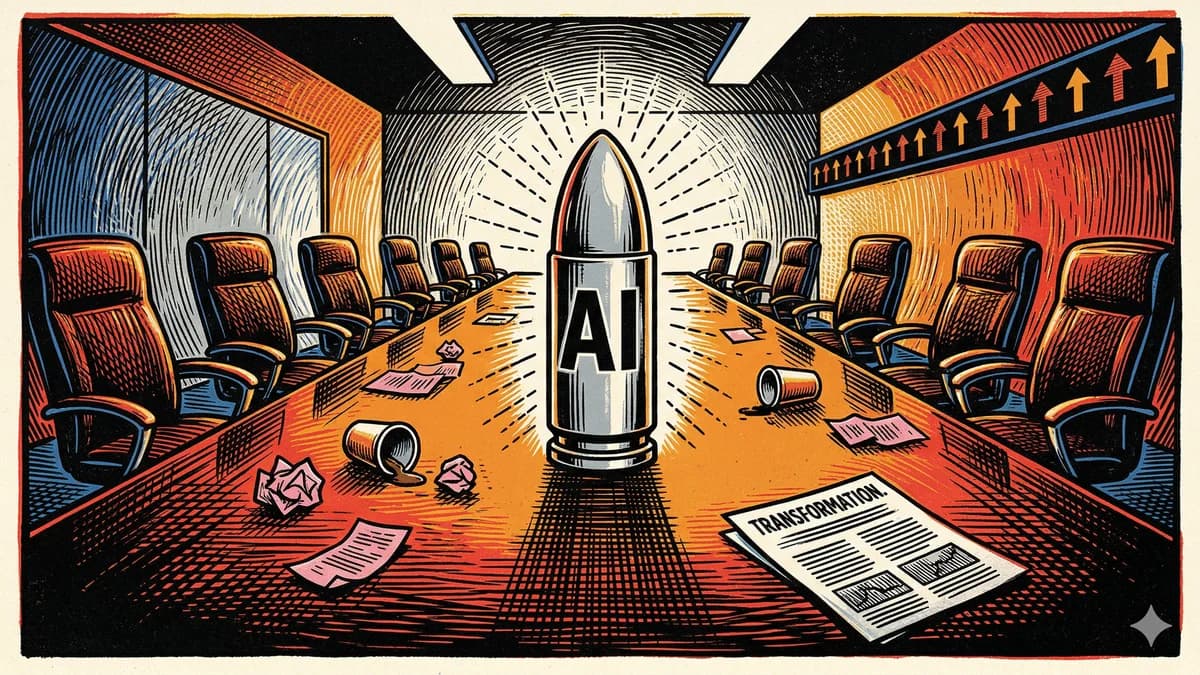
The silver bullet excuse
Marc Andreessen, not known for understatement, called the entire AI layoff narrative "a farce." His argument: every large company is overstaffed by 50%, many by 75%, all of it from pandemic-era hiring binges, and AI has become "the silver bullet excuse" that lets executives frame a messy correction as a strategic transformation. He went so far as to claim the displacement narrative is "100% incorrect."
Marc Benioff, Salesforce's CEO, called it "a lazy way out."
Harvard Business Review surveyed more than 600 executives and found something damning: most AI-driven layoffs were based on anticipated future capabilities, not demonstrated current performance. Companies are firing people for AI systems that do not work yet. They are cutting staff to make room for technology that, in many cases, has not been built, tested, or deployed at scale.
Companies are firing people for AI systems that do not work yet. The termination is real. The replacement is speculative.
The San Francisco Standard reported that nearly 60% of hiring managers acknowledged using AI as convenient cover for decisions rooted in budget pressures, revenue uncertainty, or past overhiring. Sixty percent. Not a fringe view. Not a hot take. A supermajority of the people making the calls admit the framing is, at best, aspirational.
Follow the stock price
If you want to understand why companies frame layoffs as AI efficiency rather than pandemic cleanup, look at Block.
Jack Dorsey fired 39% of his workforce in February. He posted on X that "intelligence tools have changed what it means to build and run a company" and predicted most companies would make similar structural changes within a year. Block's stock surged more than 20% in after-hours trading.
Twenty percent. For firing four thousand people and calling it innovation.
Now imagine the alternative announcement: "We overhired during the pandemic, our margins are under pressure, and we need to cut costs." That tanks a stock price. That sounds like failure. But dress the same decision in AI language and suddenly it is not a layoff, it is a transformation. Not a cut, a restructuring. Not a retreat, a pivot.
Since ChatGPT launched, AI-related stocks have accounted for 75% of S&P 500 returns. There is an enormous financial incentive to attach the letters "AI" to every corporate action, including ones that have nothing to do with artificial intelligence. A straightforward "we made bad hiring decisions" reads as leadership failure. "We're right-sizing for AI efficiency" reads as strategic vision. Same outcome. Different stock price.
Where AI is actually replacing people
None of this means AI displacement is imaginary. It is real. It is just smaller and more specific than the headlines suggest.
Customer service is the clearest case. Gartner predicts organisations will replace 20 to 30% of service agents with generative AI by the end of 2026. But even here, the data is more complicated than the prediction. Only one in five customer service leaders have actually reduced agent headcount. One quarter have paused backfills. Just over half report steady headcount while serving more customers with the same team. The replacement is happening, but it looks more like attrition than a cliff.
Coding roles are being compressed. Microsoft uses Copilot tools to absorb work previously done by junior developers. Google now factors AI use into engineer performance reviews. Meta tracks lines of code produced with AI assistance. The function still exists. The number of humans performing it is shrinking.
Amazon cited AI systems replacing human regional managers in logistics. Medical transcription is 99% automated. Paralegal work faces 80% automation exposure by year's end.
These are real changes affecting specific job categories. But they account for a fraction of the 37,638 roles supposedly eliminated by AI in Q1. The gap between genuine AI displacement and the number claimed is vast.
The boomerang
Perhaps the most telling data point: 55% of employers who cut staff citing AI already regret the decision. More than a third have rehired over half the eliminated roles within six months. Gartner predicts that half of companies that cut customer service staff for AI will need to bring humans back by 2027. Forrester estimates that over half of all AI-attributed layoffs will be "quietly reversed."
The quiet part is important. Nobody issues a press release saying "we fired 2,000 people for AI that didn't work and now we're hiring them back." The layoff gets a blog post and an earnings call mention. The rehire gets a job listing on LinkedIn and silence.
A Duke University and Federal Reserve CFO survey projects 502,000 AI-related job cuts across the US in 2026, nine times the 2025 rate. But the same survey found that only 44% of CFOs actually plan any AI-related cuts at all. Study co-author John Graham called the projections "not the doomsday job scenario." The gap between what companies say they will do and what they are actually doing is not a rounding error. It is the entire story.
The real story under the noise
The National Bureau of Economic Research surveyed C-suite executives across the US, UK, Germany, and Australia. Nearly 90% said AI had no impact on workplace employment over the past three years.
Ninety percent. After two years of breathless headlines about AI eating every job in sight.
The real driver of Q1's 78,557 cuts is more mundane than a technology revolution. It is a pandemic correction that should have happened two years ago, dressed in futurist language for investor consumption. Companies hired aggressively from 2020 to 2022, interest rates rose, growth slowed, and now the bill is due. AI provides the narrative wrapper: instead of admitting strategic misjudgment, executives get to announce a bold new AI-powered future that happens to require fewer humans.
This matters because it obscures the displacement that is actually happening. Somewhere underneath the corporate theatre, real AI systems are absorbing real tasks from real workers. Customer service agents, junior developers, data entry specialists, paralegals. These people deserve honest analysis, not a landscape polluted by companies using their job category as a press release.
The 48% figure is not a measurement of AI's impact on employment. It is a measurement of AI's impact on corporate communications.
The Federal Reserve found 1% actual AI-induced layoffs. The NBER found 90% no employment impact. Oxford Economics found no significant replacement. And the layoff trackers found 48% attribution. The distance between those numbers is not a mystery. It is a marketing budget.
When the dust settles on Q1 2026, the story will not be that AI replaced 37,638 workers. It will be that companies discovered "AI" is the most effective two-letter justification for structural decisions since "IP." The technology is real. The capability is growing. The displacement at the margins is genuine and accelerating. But the headline number is a fiction, and the people who built the technology will tell you so themselves.
Sources
- Tech industry lays off nearly 80,000 in Q1 2026, Tom's Hardware
- Sam Altman confirms AI washing in layoffs, Fortune
- Marc Andreessen calls AI layoffs "a farce", Fortune
- Oxford Economics: AI layoffs a "convenient excuse", Fortune
- Companies laying off for AI's potential, not performance, Harvard Business Review
- Oracle layoffs and AI spending, CNBC
- Block layoffs and Jack Dorsey's AI bet, CNN Business
- Is AI the strategy or the scapegoat behind Block's 40% layoff?, Darden School of Business
- Federal Reserve: AI adoption and job posting behaviour, Federal Reserve Board
- AI washing in layoffs, San Francisco Standard
- Gartner: half of AI customer service cuts will be reversed by 2027, Gartner
- The AI layoff trap: why half will be quietly rehired, HR Executive
- CFO survey: AI job cuts and the productivity paradox, Fortune
- Nearly 80,000 tech workers cut in Q1 2026, TechRadar
- Atlassian workforce reduction, CNBC