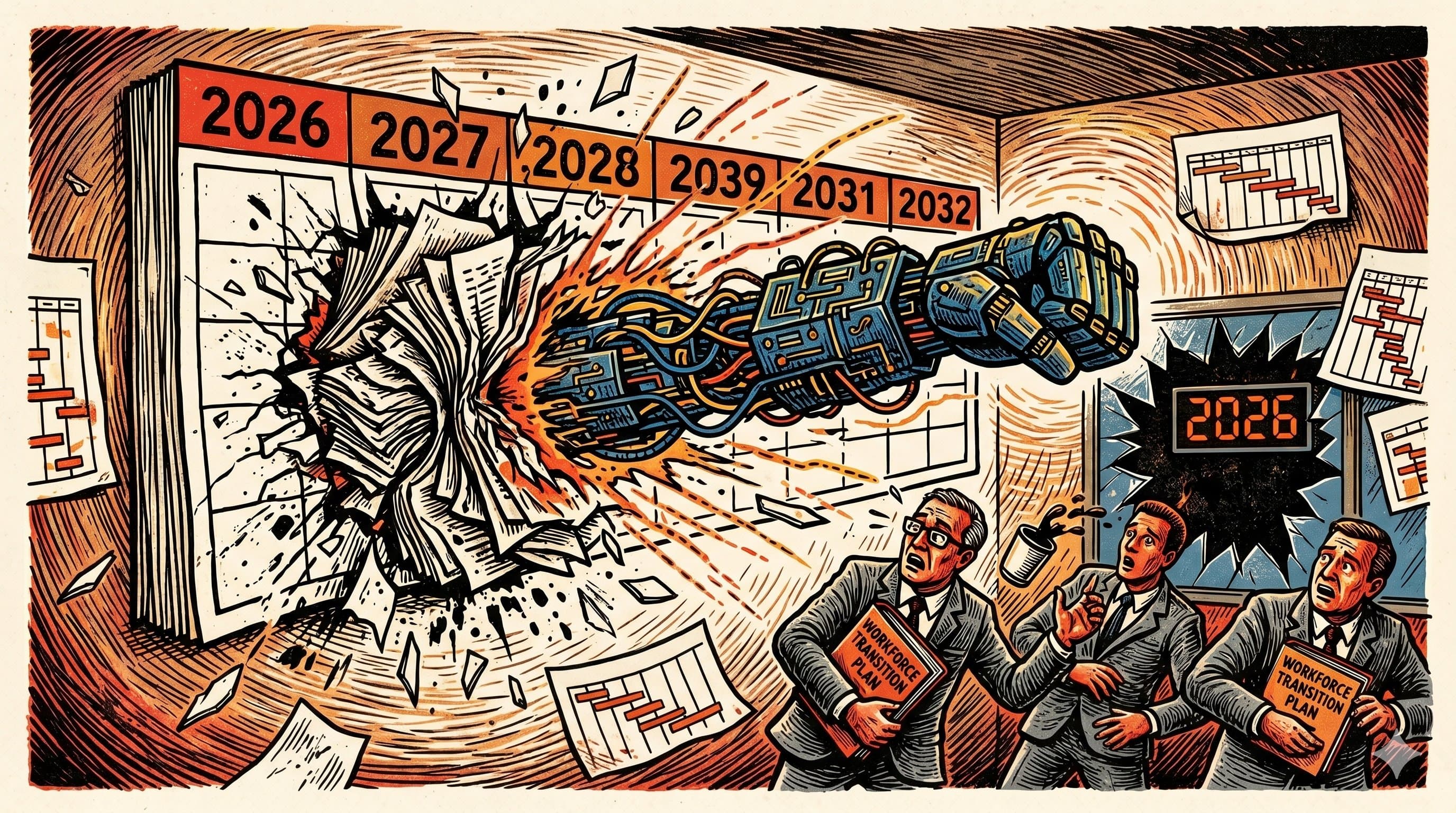

In 2023, Cognizant and Oxford Economics assessed 18,000 tasks across 1,000 professions and produced a forecast. By 2032, they said, roughly 12% of all work tasks would be fully automatable by AI. Governments cited it. Boards referenced it. HR departments built decade-long transition plans around it.
In January 2026, Cognizant updated the study. The number was 10%. Not for 2032. For now.
Six years of projected transition, compressed into three. The workforce disruption that was supposed to arrive gradually, giving institutions time to adapt, retrain, and restructure, has arrived while most of those institutions are still writing their AI strategy documents.
The numbers that should keep planners awake
Cognizant's New Work, New World 2026 report is not a think piece. It is a systematic reassessment of the same 18,000-task dataset using the same methodology, updated to account for what AI can actually do today versus what it could do in 2023. The findings are blunt.
The percentage of tasks classified as non-automatable by AI has collapsed from 57% to 32%. The average exposure score across all jobs is now 39%, which is 30% higher than what the original study forecast for 2032. And 93% of US jobs are now impacted in some way by AI, either through automation of core tasks or augmentation of adjacent ones.
The $4.5 trillion figure is the one that will travel furthest. That is the estimated value of US labour tasks that AI systems can perform today. Not in theory. Not with frontier models that exist only in labs. With commercially available tools, at current price points, deployed at scale. Cognizant is not predicting what AI might do. It is measuring what it already can.
Who is already feeling it
The data is not hypothetical. The Dallas Federal Reserve published research in January 2026 tracking employment in AI-exposed occupations since November 2022. Workers aged 22 to 25 in the most exposed roles have seen a 13% decline in employment. Not because they are being fired. Because they are not being hired. The job-finding rate for young workers entering AI-exposed fields has dropped while the rate for low-exposure fields has held steady.
The mechanism is subtle and, for that reason, more dangerous than mass layoffs. Companies are not sacking entire departments. They are simply not replacing the people who leave. Every resignation, every retirement, every contract that expires becomes an opportunity to test whether AI can absorb the work. Often, it can. The headcount drifts downward without a single redundancy notice.
Returns on experience are increasing in AI-exposed occupations. The people most at risk are not veterans. They are graduates.
The wage data adds an uncomfortable twist. Despite the employment decline, wages in AI-exposed sectors are rising faster than the national average. Computer systems design wages have climbed 16.7% since late 2022, against a 7.5% national average. The remaining workers are more productive, more experienced, and more valuable. The ones who never get in the door have no data point at all.
In March 2026, Anthropic published its own labour market analysis measuring observed AI exposure, not theoretical potential, but what is already being automated in practice. Computer programmers top the list at 74.5% observed exposure. Customer service representatives sit at 70.1%. Data entry keyers at 67.1%. The post-ChatGPT era has produced a 14% drop in the job-finding rate for exposed occupations. These are not projections. They are measurements taken from the real economy.
The consensus is fracturing
What makes March 2026 significant is not any single data point. It is the convergence. Within a single month, Cognizant, the Dallas Fed, Anthropic, Stanford's SIEPR Economic Summit, and Forrester all published research pointing in the same direction: the timeline for workforce disruption has accelerated materially beyond what anyone planned for.
The fracture is in what happens next.
At one end, the venture capital community is explicit. In a TechCrunch survey published in late December, multiple enterprise VCs independently flagged labour displacement as the most significant AI impact of 2026, even though nobody asked them about it. Jason Mendel of Battery Ventures: "2026 will be the year of agents as software expands from making humans more productive to automating work itself, delivering on the human-labor displacement value proposition in some areas." Marell Evans of Exceptional Capital was blunter: "We'll see more human labor get cut and layoffs will continue to aggressively impact the US."
At the other end, Forrester's January 2026 forecast argues for a more measured trajectory: AI will account for 6% of total US job losses through 2030, approximately 10.4 million roles, while augmenting 20% of jobs. And here is the detail that belongs in every boardroom: Forrester predicts that over half of layoffs attributed to AI will be quietly reversed, as companies discover that the AI systems they bought cannot actually replace the humans they fired.
The Stanford SIEPR summit landed somewhere between panic and caution. Employment is falling for workers who use AI to automate their tasks. It is growing for workers who use AI to learn new skills. One panellist offered a line worth holding onto: "A world where growth explodes is very likely a world of great inequality."
A world where growth explodes is very likely a world of great inequality.
Stanford SIEPR Economic Summit panellist, March 2026
The planning failure
The Cognizant data reveals something more fundamental than a faster timeline. It reveals a planning methodology that was never designed for exponential inputs.
Every major workforce strategy produced between 2023 and 2025 assumed a linear progression. A certain percentage of tasks automated each year, a steady increase in AI capability, a manageable pace of change that allowed institutions to run pilot programs, publish white papers, form committees, and eventually, in the fullness of time, do something about it.
The actual trajectory was not linear. It was not even smoothly exponential. It lurched. GPT-4 arrived in March 2023 and established a baseline. Then Claude 3.5 moved the line. Then o1 moved it again. Then Gemini 3. Then Claude Opus 4.6. Each jump invalidated the assumptions that the previous workforce plan was built on. By the time any committee had finished its review, the thing it was reviewing had already changed.
This is the institutional failure pattern that The Clock identified: organisations built for annual planning cycles trying to respond to a capability curve that doubles every 89 days.
The Cognizant study just put a price tag on the gap. Six years of expected transition, evaporated. $4.5 trillion in tasks, exposed. And the institutions that were supposed to manage this, the government agencies, the training providers, the universities, the HR departments, are still operating on the 2032 calendar.
What the February panic got right
In February 2026, AI executive Matt Shumer posted an essay to X titled "Something Big Is Happening." It was viewed over 85 million times. He compared the moment to February 2020: the pandemic approaching, the public unprepared, the signals clear to anyone watching closely.
The essay was criticised by many Wall Street economists as alarmist. Fair enough. But the Cognizant data, published two months earlier, said the same thing in spreadsheet form. So did the Dallas Fed. So did Anthropic. So did Forrester, with its more conservative numbers. The only disagreement was about magnitude, not direction.
The February panic got one thing exactly right: the gap between what insiders know and what the public understands is dangerously wide. Reuters and Ipsos polling showed 71% of Americans are concerned that AI will put "too many people out of work permanently." But concern without data produces anxiety, not action. And anxiety without a plan is just waiting with extra steps.
What this means
The World Economic Forum's Future of Jobs Report 2025 projects that by 2030, 170 million new roles will be created while 92 million are displaced, for a net gain of 78 million positions globally. That framing is useful. It is also, now, dangerously incomplete.
Net figures hide the transition cost. Seventy-eight million net new jobs is a comforting statistic if you are already in one of them. It is irrelevant if you are a 24-year-old programmer whose career never started because the entry-level role was absorbed before you graduated. The Dallas Fed data shows this is already happening. Not in 2030. Now.
The transition is not going to be managed by the institutions that were supposed to manage it. Not because those institutions are incompetent, but because they were designed for a rate of change that no longer exists. University curricula take three to five years to update. Government retraining programs take two to four years to fund, design, and deploy. Corporate transformation programs take 18 months to begin showing results. The AI capability curve, as measured by METR, doubles every 89 days.
The maths does not work. Not because the intention is wrong. Because the clock speed is mismatched by an order of magnitude.
Institutions planned for 2032. The data arrived in 2026. The gap between those two dates is not a scheduling error. It is a structural failure in how we plan for exponential change.
This is the core Outpaced thesis: not that AI is dangerous, but that the rate of change has outpaced the institutional capacity to respond. The Cognizant study just confirmed it with $4.5 trillion worth of evidence.
If your workforce strategy still references a 2030 or 2032 horizon, it is not conservative. It is obsolete. The timeline collapsed. The only question now is what you build with whatever time remains.
Sources
- Cognizant, "New Work, New World 2026," January 2026: 18,000-task reassessment: 93% job impact, 10% fully automatable, $4.5T in exposed labour.
- Cognizant, "New Work, New World 2026" full report: methodology, task exposure scores, non-automatable task decline from 57% to 32%.
- Dallas Federal Reserve, "Young workers' employment drops in occupations with high AI exposure," January 2026: 13% employment decline for workers aged 22-25 in AI-exposed roles since November 2022.
- Dallas Federal Reserve, "AI is simultaneously aiding and replacing workers," February 2026: wage paradox: 16.7% wage growth in AI-exposed sectors vs 7.5% national average.
- Anthropic, "Labour Market Impacts," March 2026: observed exposure by occupation: programmers 74.5%, customer service 70.1%, data entry 67.1%.
- Stanford Report, "How to prepare as AI reshapes the workforce," March 2026: SIEPR Economic Summit: employment falling for automators, rising for learners.
- Forrester, "AI-Led Job Disruption Will Escalate," January 2026: 6% of US jobs lost to AI through 2030 (10.4M roles); 20% augmented; over half of AI layoffs reversed.
- TechCrunch, "Investors predict AI is coming for labor in 2026," December 2025: VC survey: labour displacement flagged as top AI impact without prompting.
- World Economic Forum, "Future of Jobs Report 2025," January 2025: 170M new roles, 92M displaced, net +78M by 2030.
- Fortune, "The week the AI scare turned real," February 2026: Shumer essay viewed 85M+ times; Citrini Research global intelligence crisis essay.
- AllWork.Space, "AI Disruption Is Moving The Future Of Work Up By Six Years," March 2026: timeline compression analysis of the Cognizant data.